We use cookies to help give you the best possible browsing experience. Using our site implies your consent, click here to read more.
Don't show again


* No subscription
"I really do believe you guys have cracked the code - I am truly terrible at languages, but your system sticks in my brain, it must be magic!"
Row Turner, The British Forces Broadcasting Service


Standard romances worry about meeting the parents. Medical romances worry about a patient dying mid-proposal. The proximity to mortality strips away pretense. Vanity, gamesmanship, and "playing hard to get" dissolve in the face of a ruptured aneurysm. Consequently, in medical fiction feel urgent. Characters say "I love you" not because the episode runtime requires it, but because a code stroke reminded them that time is a finite resource.
Fetishization refers to the attribution of special or mystical properties to an object or aspect of the body. When applied to medical or gynecological contexts, it implies a deviation from the professional and clinical approach to a more personalized, often sexualized, view. This can lead to ethical and legal issues, especially if it involves recordings or visual documentation without proper consent and ethical adherence.
The most realistic obstacle in a medical romance is time . A 36-hour shift destroys plans. A romantic storyline that acknowledges the mundane reality of canceled dinners and missed anniversaries is infinitely more touching than a spontaneous helicopter rescue.
You know the 'earworm' effect, catchy music and lyrics that you can't get out of your head?
Using the phenomenal power of music, the Earworms Method plants the words of a foreign language into the auditory cortex of your brain - ready for instant recall.
Using music as the medium is not only fun and entertaining, it is also highly effective.
Firstly, music primes the neural networks and puts the learner into the optimum state of consciousness for learning, the so-called Alpha state; relaxed but at the same time receptive.
Secondly, music engages and stimulates both right and left hemispheres of the brain, unleashing more learning potential. Music also allows for repetition without monotony.
All these features together lead to a much higher rate of retention than with traditional learning methods.
Instead of seeing a language in terms of individual words and grammar, the Earworms approach immerses the learner in real-life dialogues and expressions.
These are then broken down into smaller bite-size chunks, practiced rhythmically with music and then reconstructed into full sentences.
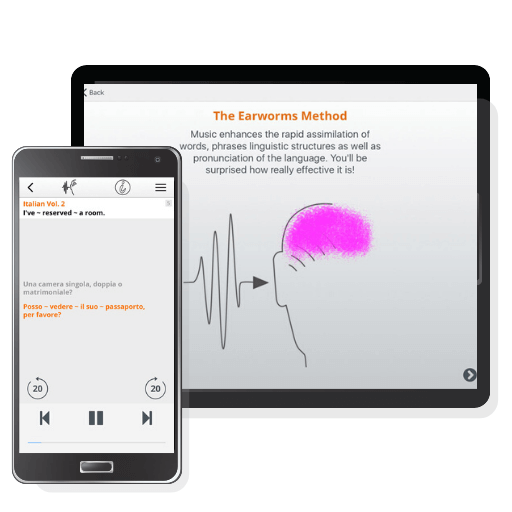
The Earworms App now features a karaoke-like synchronised text function, which gives an extra bit of visual input to reinforce the audio learning effect. It also includes a downloadable PDF transcript of the course.
"Brilliant! Should be a famous learning technique." - Molar
"I love this programme, and find I'm remembering words and phrases effortlessly. Brilliant product." - Churchpolly


Standard romances worry about meeting the parents. Medical romances worry about a patient dying mid-proposal. The proximity to mortality strips away pretense. Vanity, gamesmanship, and "playing hard to get" dissolve in the face of a ruptured aneurysm. Consequently, in medical fiction feel urgent. Characters say "I love you" not because the episode runtime requires it, but because a code stroke reminded them that time is a finite resource.
Fetishization refers to the attribution of special or mystical properties to an object or aspect of the body. When applied to medical or gynecological contexts, it implies a deviation from the professional and clinical approach to a more personalized, often sexualized, view. This can lead to ethical and legal issues, especially if it involves recordings or visual documentation without proper consent and ethical adherence. Standard romances worry about meeting the parents
The most realistic obstacle in a medical romance is time . A 36-hour shift destroys plans. A romantic storyline that acknowledges the mundane reality of canceled dinners and missed anniversaries is infinitely more touching than a spontaneous helicopter rescue. Vanity, gamesmanship, and "playing hard to get" dissolve